Introduction
Legal notice vs demand letter is often the most effective middle step when a dispute stalls.
When a dispute stalls, people jump straight to lawsuits—or do nothing at all. In practice, the most effective middle step is often a legal notice or demand letter. These documents clarify the issue, state what you want, and set a deadline—without filing in court.
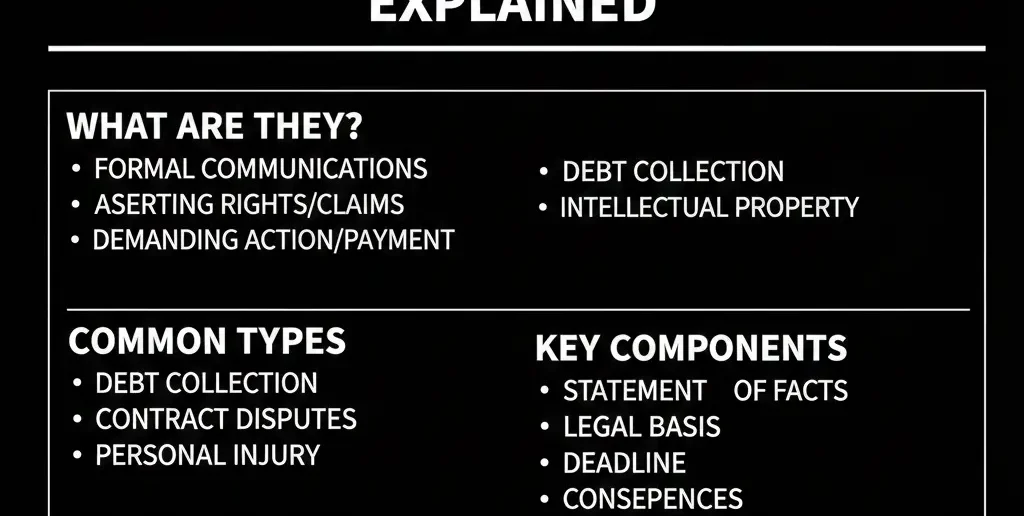
This guide explains legal notices and demand letters in plain language: the difference between them, when each makes sense, and how to write one that gets results. The key insight many articles miss: clarity and tone matter more than threats. Courts and counterparties respond better to precise, reasonable requests than aggressive posturing.
Legal notice vs demand letter (what’s the difference?)
Legal notice
A legal notice formally informs the other party of a legal issue or breach and preserves your rights. It often:
- cites the issue,
- references obligations,
- signals possible next steps.
Demand letter
A demand letter asks for a specific remedy—payment, action, or cessation—by a clear deadline.
[Expert Warning] Confusing the two leads to vague letters that neither preserve rights nor secure resolution.
When to use each (quick decision guide)
Use a legal notice when…
- you need to preserve rights or deadlines,
- the facts are still disputed,
- statutes or contracts require notice.
Use a demand letter when…
- the breach is clear,
- you know exactly what you want,
- you’re ready to escalate if ignored.
Table: Legal notice vs demand letter at a glance
| Feature | Legal notice | Demand letter |
| Primary purpose | Preserve rights | Obtain remedy |
| Tone | Formal, neutral | Firm but reasonable |
| Specific demand | Optional | Required |
| Deadline | Often implied | Explicit |
| Court impact | Shows notice | Shows good-faith effort |
What every effective letter must include
1) Clear facts (brief and verifiable)
State:
- who you are,
- what happened,
- when it happened.
Avoid emotional language.
2) Legal basis (plain language)
You don’t need statutes—just explain the obligation breached (contract term, notice rule, service standard).
3) Specific request
Say exactly what you want:
- amount,
- action,
- correction.
4) Reasonable deadline
Give a clear date. Courts favor reasonable timelines.
5) Next steps (without threats)
State you’ll consider further action if unresolved—don’t over-threaten.
[Pro-Tip] Precision beats intimidation. Vague threats weaken credibility.
Information Gain (SERP gap): tone predicts outcomes
Most guides focus on format. Outcomes hinge on tone alignment.
Counter-intuitive insight:
Letters that sound ready—but not eager—to litigate get faster responses. Calm firmness signals confidence.
Unique section: Real-world scenario
A demand letter that resolved a dispute in 10 days
A tenant sent a concise demand letter:
- cited the lease clause,
- requested the deposit balance,
- set a 10-day deadline,
- attached photos and receipts.
No threats. Payment arrived on day nine.
Common mistakes
Mistake — Over-lawyering the letter
Fix: Use plain language; keep it one page when possible.
Mistake — No deadline
Fix: Add a specific, reasonable date.
Mistake — Sending it publicly
Fix: Send privately first; preserve proof of delivery.
Mistake — Inconsistent demands
Fix: Decide the remedy before writing.
[Money-Saving Recommendation] A clean, early letter often avoids filing fees entirely.
How to send it (and prove delivery)
Delivery best practices
- email + certified mail (when appropriate),
- keep timestamps,
- save copies and receipts.
Documentation matters if you later escalate.
Natural transition
People unsure about wording often use letter templates or guided tools to structure notices, then customize facts and tone. The value is consistency—not automation.
FAQs
- Is a demand letter legally required?
Sometimes—contracts or statutes may require notice first. - Do I need a lawyer to send one?
Often no, if the issue is straightforward. - Can a demand letter be used in court?
Yes—it can show good-faith effort. - How long should the deadline be?
Reasonable—often 7–14 days, depending on context. - Should I threaten a lawsuit?
State next steps calmly; avoid aggressive threats. - What if there’s no response?
Document the silence and consider escalation.
Conclusion
Legal notices and demand letters are leverage tools—not weapons. When you state facts clearly, ask for a specific remedy, and set a fair deadline, you create a path to resolution without court. Precision, tone, and documentation do the heavy lifting.
Internal link
Small Claims vs Mediation: Which Should You Choose?