Introduction
Documentation is the foundation of every successful legal claim—but most people start documenting too late or do it incorrectly. Whether the issue involves work, housing, consumer disputes, or authorities, poor documentation weakens even valid legal rights.
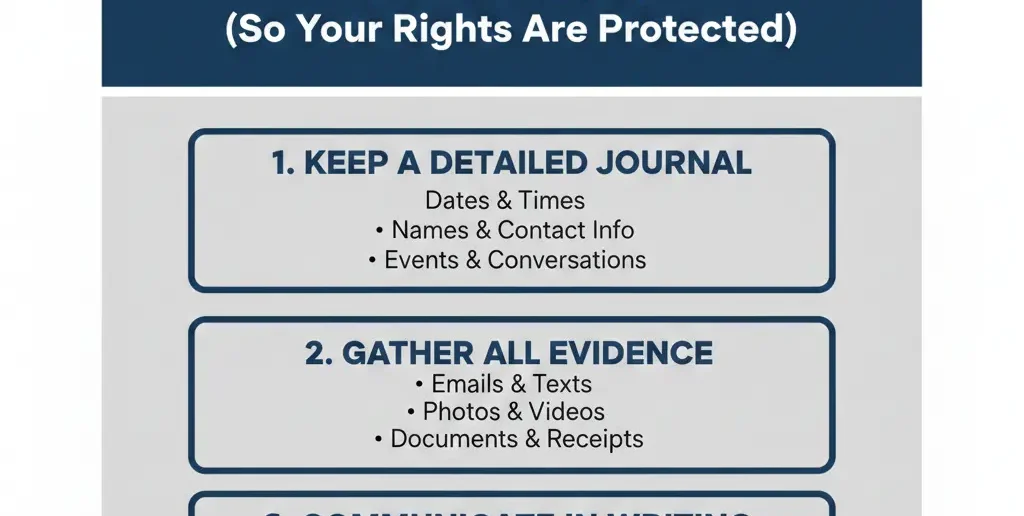
This guide explains how to document a legal issue properly, step by step. You’ll learn what information matters, how to keep records legally clean, and why early documentation often resolves problems before they escalate. The key insight: documentation isn’t about confrontation—it’s about clarity and control.
Why documentation matters more than confrontation
Legal disputes rarely hinge on emotions or arguments. They hinge on:
timelines
consistency
written records
Without documentation:
claims become “he said, she said”
deadlines are missed
leverage disappears
With documentation:
positions stabilize
retaliation becomes harder
resolution paths expand
What counts as legal documentation?
Legal documentation includes:
written notes
emails or messages
contracts or policies
invoices or receipts
photos or screenshots
official notices
Important: Documentation does not need to be formal to be powerful—it needs to be accurate and timely.
Step-by-step: how to document a legal issue properly
Step 1: Start immediately (even if you’re unsure)
Begin documenting as soon as something feels wrong.
Record:
date and time
location
who was involved
exact words used (if possible)
You don’t need certainty—only consistency.
Step 2: Use a private, chronological log
Keep one running document (digital or notebook).
Each entry should include:
date
event description
outcome or response
any follow-up needed
Why it matters: Chronology shows patterns, not isolated complaints.
Step 3: Preserve original materials
Save:
emails (don’t edit)
messages (screenshots + originals)
letters
policies in effect at the time
Never overwrite originals.
Copies protect integrity.
Step 4: Move verbal conversations into writing
If something is said verbally, summarize it calmly in writing.
Example:
“Following up on today’s discussion, my understanding is…”
This creates a record without accusation.
Step 5: Label documents clearly
Use clear filenames:
2026-01-12_rent_increase_notice.pdf
2026-01-15_hr_meeting_summary.docx
Avoid vague names like “notes1” or “important”.
What NOT to do when documenting
Don’t exaggerate
Stick to facts only.
Don’t threaten
Documentation is not a warning letter.
Don’t overshare
Only document what’s relevant.
Don’t edit history
Corrections should be new entries, not rewrites.
Documentation by situation (quick guide)
Situation What to document
Workplace Schedules, warnings, emails, policy changes
Housing Notices, repair requests, entry attempts
Consumer Receipts, promises, refund timelines
Authorities Names, badge numbers, reasons given
Services Cancellations, delays, written terms
Beginner mistake most people make
Waiting until damage is severe
People document after termination, eviction, or loss.
Fix:
Document when confusion starts—not when consequences hit.
Early notes often prevent escalation entirely.
How documentation protects you legally
Proper documentation:
strengthens credibility
supports deadlines
discourages retaliation
speeds resolution
lowers legal costs
Even if you never escalate, documentation changes behavior.
When documentation is enough (no escalation needed)
Many issues resolve once:
communication is written
timelines are visible
patterns are clear
Money-saving insight:
Clear documentation often solves problems without lawyers or complaints.
FAQs
- Do I need proof to start documenting?
No. Start with notes—proof builds later.
- Can my notes be used legally?
Yes, especially if created close to events.
- Should I tell the other party I’m documenting?
Not necessary early on.
- Is recording conversations allowed?
Depends on local law—check consent rules.
- How long should I keep records?
Until all deadlines and disputes are resolved.
Conclusion
Knowing how to document a legal issue properly gives you quiet power. Documentation doesn’t escalate conflict—it prevents confusion. When you record facts early, preserve originals, and communicate clearly, you protect your rights long before disputes turn costly or permanent.
Internal link
Signs Your Legal Rights Are Being Violated