Introduction
How judges decide evidence admissibility often surprises people who assume strong evidence always gets through.
Many people think judges “go with their gut” when ruling on evidence. In reality, admissibility decisions follow a disciplined process grounded in evidence law. Judges act as gatekeepers, deciding what the jury is allowed to see and what must stay out to protect fairness and accuracy.
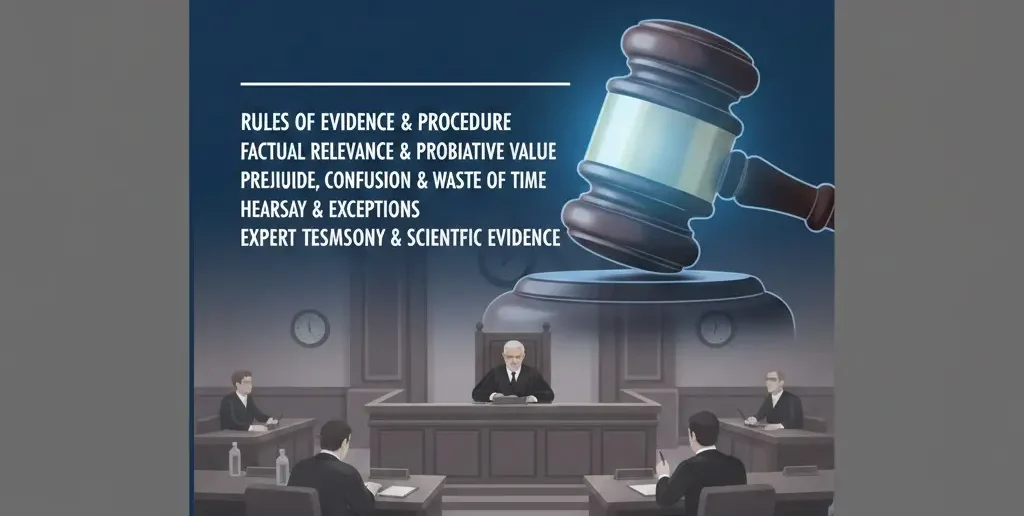
This article explains how judges decide whether evidence is admissible, using the same mental checklist courts rely on during trials and hearings. You will see how objections work in real time, why judges sometimes exclude evidence that seems powerful, and the practical preparation steps that make admissibility more likely. The key insight many guides miss is that judges rule on procedure first—impact second.
The judge’s gatekeeping role
Judges control what enters the courtroom record
Before evidence reaches a jury (or influences a bench trial), judges ensure it:
- follows procedural rules,
- respects legal rights,
- won’t unfairly prejudice the fact-finder.
[Expert Warning] Admissibility rulings are about fairness—not deciding who is right.
The four-step filter judges apply
Step 1 — Relevance
Judges first ask whether the evidence helps prove or disprove a fact in dispute. If it doesn’t move the case forward, it’s excluded immediately.
Step 2 — Authenticity
Next, judges ask whether the evidence is what the party claims it is. This usually requires:
- a witness who can identify it, or
- documentation showing how it was created and preserved.
Step 3 — Reliability
Judges consider whether the evidence can be trusted:
- Was it altered?
- Was it collected properly?
- Is the source credible?
Step 4 — Exclusionary rules
Even relevant, authentic evidence can be excluded if it violates rules such as:
- hearsay,
- privilege,
- illegal collection,
- unfair prejudice outweighing value.
Table: How judges analyze evidence step by step
| Judge’s question | What they’re testing | Common reason for exclusion |
| Is it relevant? | Connection to dispute | Irrelevant or distracting |
| Is it authentic? | Is it real? | No foundation |
| Is it reliable? | Can it be trusted? | Altered or unclear source |
| Is it allowed? | Rule compliance | Hearsay, privilege, illegality |
What happens when a lawyer objects
Objections pause the evidence
When a lawyer objects:
- the judge stops the presentation,
- hears brief arguments,
- rules immediately or later.
Judges often rule without emotion—they apply rules, not sympathy.
Sidebar and evidentiary hearings
Sometimes judges hold:
- sidebars (short, private discussions), or
- evidentiary hearings (longer reviews outside the jury’s presence).
These protect the jury from seeing excluded evidence.
Information Gain (SERP gap): judges think in “risk management”
Most articles frame admissibility as yes/no. Judges often think in risk terms.
Counter-intuitive insight:
If evidence risks confusing the jury or unfairly inflaming emotions, judges may exclude it—even when it’s technically relevant. Predictability and fairness outweigh dramatic impact.
Unique section: Myth vs Reality
Myth vs Reality — judicial evidence decisions
- Myth: Judges exclude evidence to help one side.
Reality: Judges exclude evidence to protect the process. - Myth: Strong evidence always gets in.
Reality: Procedural flaws block even strong proof. - Myth: Admissibility equals credibility.
Reality: Admissibility comes first; credibility comes later.
Common mistakes that lead to exclusion
Mistake — Skipping foundation
Fix: Always be ready to explain who created the evidence and how it was preserved.
Mistake — Offering summaries without originals
Fix: Bring originals and use summaries only when allowed.
Mistake — Ignoring hearsay rules
Fix: Know exceptions or prepare a different witness.
[Pro-Tip] If you can’t explain evidence in 30 seconds, the judge may not admit it.
Practical preparation: how to think like a judge
Prepare answers to four questions
Before offering any evidence, be ready to answer:
- Why is it relevant?
- How do you know it’s authentic?
- Why is it reliable?
- Why isn’t it excluded?
This mirrors the judge’s decision path.
FAQS
- Who decides if evidence is admissible?
The judge—not the jury—decides admissibility. - Can judges exclude relevant evidence?
Yes, if it violates exclusionary rules or is unfairly prejudicial. - Do judges review evidence before trial?
Often yes, through motions and evidentiary hearings. - What is the most common reason evidence is excluded?
Lack of foundation or hearsay violations. - Does admissibility mean the judge believes it?
No—credibility is assessed later by the fact-finder. - Can excluded evidence ever come back in?
Sometimes, if the foundation is corrected.
Conclusion
Understanding how judges decide whether evidence is admissible means thinking like a gatekeeper, not an advocate. Judges apply a structured filter focused on relevance, authenticity, reliability, and fairness. When you prepare evidence to survive that filter, you dramatically increase the chance that the court actually hears your case—because admissibility is the doorway to persuasion.
Internal link
What Evidence Is Admissible in Court? Explained