Introduction
People often assume rights violations look obvious—illegal threats, police misconduct, or blatant discrimination. In reality, most violations unfold quietly: a landlord stops responding, an employer “changes policy,” a company delays refunds indefinitely. These moments create confusion, not certainty.
This guide explains the signs your legal rights are being violated across work, housing, consumer disputes, and interactions with authorities. You’ll learn how to spot early warning signals, why timing matters, and what steps to take before the situation escalates. The insight many guides miss is simple but critical: violations are patterns, not single events—and early action preserves options.
The universal warning signs (across most situations)
1) Sudden rule changes without notice
When policies or expectations shift overnight—especially after you raise a concern—it’s a red flag.
Why it matters:
Many laws require notice or consistency. Silent changes often signal overreach or retaliation.
2) Pressure to keep things “off the record”
Requests like:
“Let’s not put this in writing”
“This is just between us”
“Don’t involve anyone else”
Why it matters:
Rights violations thrive in silence.
Expert Warning: If someone avoids documentation, it’s rarely for your benefit.
3) Missed or ignored deadlines
Repeated delays without explanation—repairs, refunds, responses—can indicate rights are being disregarded.
Why it matters:
Deadlines are legal safeguards, not suggestions.
4) Retaliation after you speak up
If consequences follow a complaint—reduced hours, exclusion, threats—this may itself be a violation.
Why it matters:
Many laws protect people who assert their rights.
5) Selective enforcement
Rules applied only to you (but not others) often signal discrimination or retaliation.
Warning signs by everyday context
| Context | Common warning sign | What it suggests |
| Workplace | Sudden discipline | Retaliation |
| Housing | Verbal-only demands | Avoiding records |
| Consumer | Endless delays | Bad-faith practice |
| Police stop | Vague authority | Rights confusion |
| Services | Threats to cancel | Coercion |
Context-specific red flags to watch closely
At work
Discipline without explanation
Policy enforcement only after complaints
Pressure not to contact HR
In housing
Entry without notice
Deposit deductions without accounting
Repairs delayed indefinitely
In consumer disputes
Refusal to provide written terms
“Final” decisions with no appeal path
Ignoring statutory refund periods
During police or authority interactions
Unclear basis for stops or searches
Pressure to answer unrelated questions
Denial of basic procedural rights
Information Gain: patterns beat proof early
Most guides say “gather evidence.” Early on, you often don’t have proof yet.
Counter‑intuitive insight:
Recognizing patterns early allows you to document before violations harden—often preventing escalation entirely.
Beginner mistake most people make
Waiting for certainty
People wait until they’re “sure” a violation occurred.
Fix:
Act when signs appear, not when damage is done. Documentation and calm questions are safe early moves.
What to do the moment you spot warning signs
Step 1 — Start a private record
Write down:
dates and times
who said what
witnesses
documents involved
Step 2 — Move communication to writing
Follow up verbally discussed issues with a calm written summary.
Step 3 — Ask clarifying questions
Neutral phrasing:
“Can you confirm the policy change and effective date?”
“What notice applies here?”
Step 4 — Protect deadlines
Note limitation periods and response windows immediately.
Pro‑Tip: Calm documentation is the strongest early defense.
When to escalate (and when not to)
Escalate if…
deadlines are approaching,
retaliation occurs,
rights are clearly denied.
Pause if…
clarification may resolve the issue,
emotions are high,
facts are still emerging.
Money‑Saving Recommendation: Early, documented clarification often resolves issues without legal action.
Natural transition
People often use rights‑check tools or legal information platforms to validate concerns once warning signs appear—before escalating formally. The value is confirming direction, not confrontation.
Internal linking (Category 4)
Know your legal rights → Post 1
How to assert your legal rights without retaliation → Post 2
What to do before contacting a lawyer → Post 3
Legal notices and demand letters explained → Post 4
Small claims vs mediation → Post 5
YouTube embeds (contextual)
Place after “Universal warning signs” section:
https://www.youtube.com/watch?v=Qd2FqY7k3nM
https://www.youtube.com/watch?v=K7u6rC8m2nE
Image & infographic suggestions (1200×628)
Featured image
Filename: signs-your-legal-rights-are-being-violated-1200×628.png
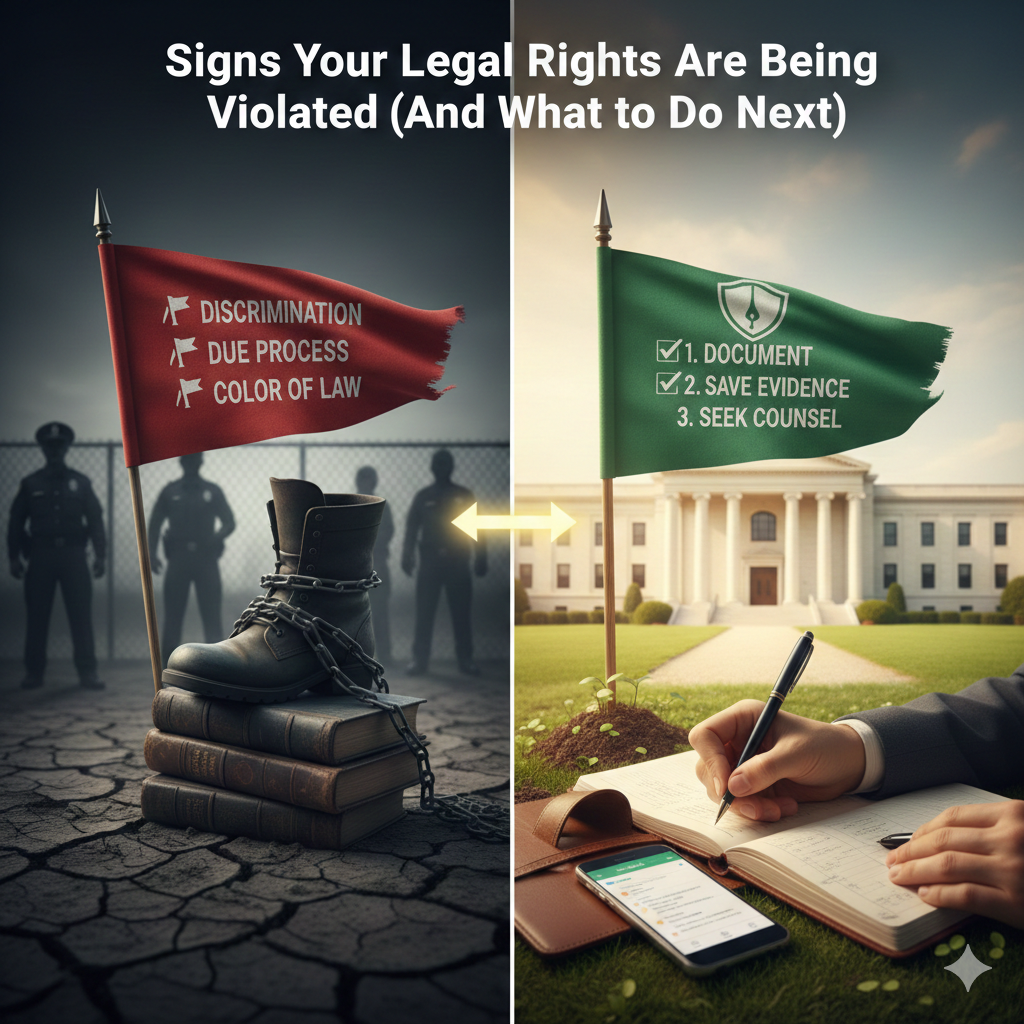
Alt text: Warning signs that your legal rights are being violated in everyday situations.
Prompt: Illustration showing warning icons around workplace, housing, consumer, and authority scenarios. Clean, approachable style.
Infographic
Filename: legal-rights-violation-warning-signs-1200×628.png
Alt text: Infographic showing early warning signs of legal rights violations.
Prompt: Checklist‑style infographic with icons for retaliation, silence pressure, missed deadlines, selective enforcement.
FAQ (Schema‑ready)
How do I know if my legal rights are being violated?
Look for patterns like retaliation, silence pressure, or missed deadlines.
Should I confront the other party immediately?
Not aggressively—document first, ask calmly.
What if I’m not sure yet?
Start documenting; you don’t need certainty to protect yourself.
Can violations be subtle?
Yes—most start quietly before escalating.
When should I seek legal advice?
When deadlines approach or retaliation occurs.
Does documenting mean I’m escalating?
No—it preserves options.
Conclusion
Recognizing the signs your legal rights are being violated early gives you leverage. Rights erode through silence, confusion, and delay—not overnight disasters. When you notice patterns, document calmly, and ask precise questions, you protect yourself long before disputes spiral.