

Introduction
How lawyers use smart contracts looks very different in practice than the popular narrative of “self-executing law.”
Practicing lawyers do not treat smart contracts as replacements for legal agreements. In real cases—commercial deals, supply chains, licensing, and compliance—smart contracts are tools that execute agreed steps while lawyers design the guardrails. When disputes arise, courts ask about intent, consent, remedies, and evidence; that’s where lawyers add value.
This article explains how lawyers use smart contracts in practice: drafting hybrid agreements, auditing code for legal risk, structuring remedies, managing compliance, and handling disputes when code misfires. You’ll also see the SERP-gap insight many articles miss—why lawyers intentionally add friction (pauses, overrides, arbitration hooks) to increase enforceability and trust.
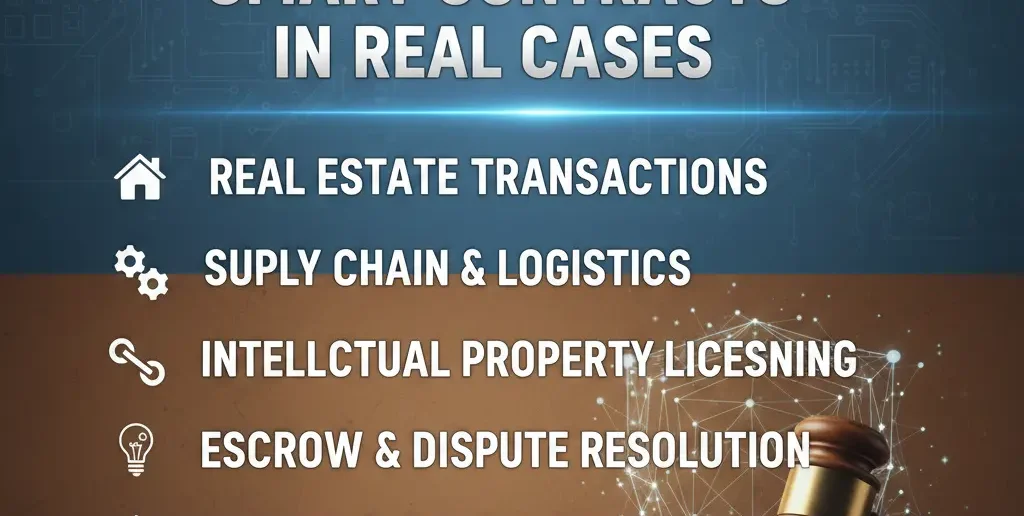
Where smart contracts fit in real legal workflows
Smart contracts automate performance, not obligations
Lawyers use smart contracts to:
- release payments on objective triggers,
- enforce timelines and milestones,
- log events for audit trails.
The obligations still live in a legal agreement; the code performs selected actions.
[Expert Warning] Automation without remedies increases risk. Lawyers design exits before they design execution.
The five most common ways lawyers use smart contracts
1) Drafting hybrid contracts (text + code)
Lawyers draft a human-readable agreement that:
- defines rights and duties,
- sets governing law and venue,
- specifies dispute resolution.
A smart contract then executes parts of that agreement (payments, access, escrows).
2) Code audits for legal risk
Before deployment, lawyers review:
- whether code matches written terms,
- edge cases and failure states,
- disclosure adequacy for consent.
This prevents “perfect execution, flawed agreement.”
3) Compliance and controls
In regulated settings, lawyers:
- map code actions to compliance rules,
- require logs and reporting,
- limit automation scope to objective facts.
4) Evidence and audit trails
Smart contracts can create:
- time-stamped records,
- verifiable logs,
- tamper-evident proofs.
Lawyers align these records with chain-of-custody practices so they’re court-ready.
5) Dispute handling and remediation
When something breaks, lawyers rely on:
- pause/kill switches,
- arbitration triggers,
- off-chain remedies (refunds, damages).
Table: How lawyers use smart contracts by practice area
| Practice area | Smart contract role | Lawyer’s value |
| Commercial deals | Milestone payments | Draft terms & remedies |
| Licensing/IP | Usage tracking | Define scope & enforcement |
| Supply chain | Delivery triggers | Manage disputes & evidence |
| Finance | Escrow automation | Compliance & risk controls |
| Litigation | Evidence logs | Admissibility strategy |
How lawyers design “court-friendly” smart contracts
Intent-first architecture
Lawyers insist on:
- clear consent flows,
- visible terms,
- affirmative acceptance.
Remedy-aware automation
They add:
- pause/override controls,
- refund logic,
- arbitration or court escalation.
[Pro-Tip] The more irreversible the code, the more conservative courts become. Reversibility increases trust.
Information Gain (SERP gap): Why lawyers add friction on purpose
Most content praises speed. Practitioners add friction:
- waiting periods,
- confirmations,
- human checkpoints.
Counter-intuitive insight:
Measured friction reduces disputes and increases enforceability because it documents intent and prevents accidental execution.
Unique section: Myth vs Reality
Myth vs Reality — lawyers and smart contracts
- Myth: Lawyers slow innovation.
Reality: They prevent costly failures. - Myth: Smart contracts eliminate disputes.
Reality: They change dispute types. - Myth: Code replaces contracts.
Reality: Contracts govern code.
Common mistakes lawyers prevent (and how)
Mistake — Code-only agreements
Fix: Hybrid contracts with readable terms.
Mistake — No failure plan
Fix: Pause, refund, and dispute hooks.
Mistake — Vague consent
Fix: Explicit acceptance tied to execution.
[Money-Saving Recommendation] Spending on review and audits upfront is far cheaper than litigating an automated mistake.
Natural transition
Teams implementing smart contracts often work with legal-tech advisors who combine drafting, audits, and compliance mapping. The payoff isn’t faster execution—it’s fewer disputes and defensible outcomes.
FAQs
- How do lawyers use smart contracts today?
To automate performance while legal agreements govern rights and remedies. - Do lawyers write smart contract code?
Usually they review and align code with legal terms; engineers implement. - Are smart contracts safe without lawyers?
They’re riskier—legal review reduces disputes and losses. - What happens when a smart contract fails?
Lawyers rely on remedies, pauses, and dispute resolution clauses. - Do courts understand smart contracts?
Courts focus on intent, consent, and remedies—lawyers translate the tech. - Is a hybrid contract necessary?
For most real cases, yes—it’s the safest approach.
Conclusion
How lawyers use smart contracts is less about replacing law and more about disciplining automation. By pairing code with clear agreements, consent, remedies, and evidence practices, lawyers make smart contracts work in the real world—where disputes happen and courts decide outcomes. Automation performs; law protects.
Internal link
How to Maintain Chain of Custody for Digital Evidence
External link
https://legittai.com/blog/case-studies-of-smart-contract-implementation-in-various-industries
