Introduction
When a dispute won’t resolve informally, most people face a fork in the road: small claims court or mediation. Both are designed to avoid the cost and complexity of full litigation—but they work very differently. Choosing the wrong one can waste time, money, and leverage.
This guide breaks down small claims vs mediation in practical terms: how each works, what outcomes to expect, and common mistakes that derail results. The insight many guides miss: your objective matters more than being “right.” If you want a judgment, go to court. If you want a workable solution—especially where relationships matter—mediation often wins.
How small claims court works
What it is
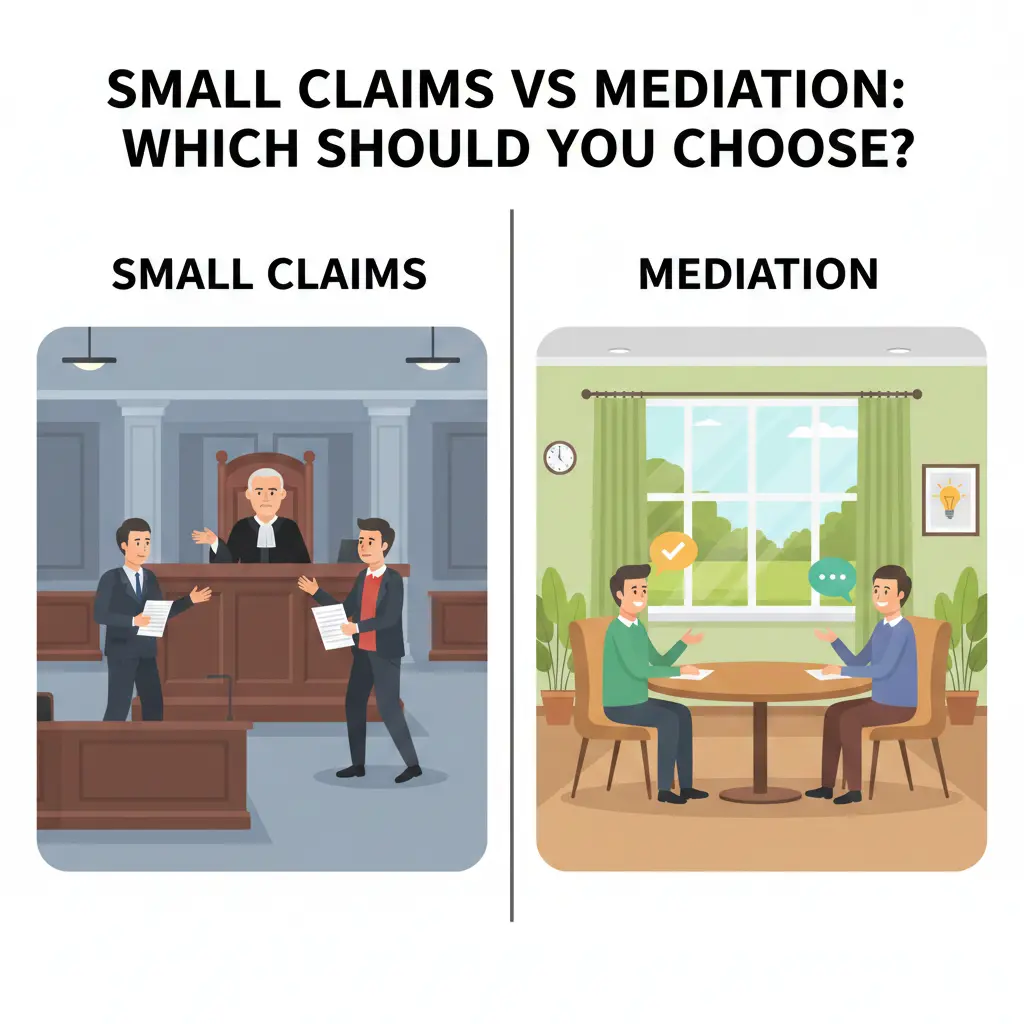
Small claims court is a simplified courtroom process where a judge decides the outcome. Rules are streamlined; lawyers may be limited or optional.
What you get
- A binding judgment
- Enforceable orders (money or specific relief)
- Clear winner/loser outcome
What it costs
- Filing fees (usually modest)
- Preparation time
- Possible enforcement costs

[Expert Warning] Winning a judgment doesn’t guarantee payment—you may still need to enforce it.
How mediation works
What it is
Mediation is a guided negotiation led by a neutral mediator. The mediator doesn’t decide the case; the parties do.
What you get
- A voluntary agreement
- Flexible solutions (payment plans, repairs, apologies)
- Faster resolution

What it costs
- Mediator fees (often shared)
- Minimal prep
- No enforcement costs if complied with
[Pro-Tip] Mediation works best when both sides want closure—even if they disagree on fault.
Table: Small claims vs mediation (side-by-side)
| Factor | Small claims | Mediation |
| Decision-maker | Judge | Parties |
| Outcome | Binding judgment | Negotiated agreement |
| Speed | Moderate | Fast |
| Cost | Low–moderate | Low |
| Control | Low | High |
| Relationship impact | Adversarial | Collaborative |
| Enforcement | Court-backed | Voluntary (can be formalized) |
When small claims is the better choice
Choose small claims if…
- the other side refuses to negotiate
- you need a binding decision
- the facts are clear and documented
- power imbalance exists
Example: Unpaid invoice with clear proof and no response to a demand letter.
When mediation is the better choice
Choose mediation if…
- you want speed and flexibility
- you value preserving a relationship
- emotions are blocking progress
- creative solutions matter
Example: Ongoing neighbor or business relationship with shared interests.
Information Gain (SERP gap): leverage shifts after each step
Most guides present a static choice. In practice, sequence creates leverage.
Counter-intuitive insight:
Starting with mediation can strengthen your small claims case later by showing good faith—and by clarifying the real issues before a judge ever sees them.
Unique section: Myth vs Reality
Myth vs Reality — choosing the right forum
- Myth: Mediation means compromise and weakness.
Reality: It’s a strategic choice that often saves money. - Myth: Small claims is always faster.
Reality: Mediation often resolves disputes in days. - Myth: You can’t enforce mediation outcomes.
Reality: Agreements can be written and enforced like contracts.
Common mistakes
Mistake — skipping a demand letter
Fix: Send a clear demand first; it frames both mediation and court.
Mistake — bringing emotions into mediation
Fix: Focus on interests and outcomes, not blame.
Mistake — poor evidence prep for small claims
Fix: Organize documents, timelines, and witnesses early.
[Money-Saving Recommendation] One mediation session can cost less than enforcing a small-claims judgment.
How to decide in 5 minutes (quick checklist)
The “GOAL” test
- Goal: Do I want a judgment or a solution?
- Opposition: Will they negotiate?
- Amount: Is it within small-claims limits?
- Long-term: Will we interact again?
Your answers usually point clearly to one path.
Natural transition
People unsure which path fits often use dispute-resolution guides or screening tools to assess goals, evidence strength, and costs before choosing mediation or court. Clarity upfront prevents regret later.
FAQS
- Is mediation legally binding?
Only if you sign an agreement; it can be enforceable. - Can I try mediation before small claims?
Yes—and it often helps later. - Is small claims court expensive?
Usually low-cost, but enforcement can add expense. - Do I need a lawyer for small claims?
Often no, depending on jurisdiction. - What if mediation fails?
You can still go to small claims. - Which is faster overall?
Mediation is usually fastest.
Conclusion
Choosing small claims vs mediation isn’t about who’s right—it’s about what works. If you want a decision, choose court. If you want resolution, choose mediation. When you match the forum to your goal, disputes end faster and with fewer regrets.
Internal link
Legal Notices and Demand Letters Explained